I tell
I speak your visitor's language. You write your site once.
A Polish visitor on a Ukrainian site asks in Polish and gets Polish. A German one, German. Out loud, if they asked out loud. Your pages stay in the language you wrote them in.
Czy dostawa do Krakowa jest darmowa?
Tak — od 500 zł dostawa do Polski jest bezpłatna. Otworzyć stronę dostawy?
(a Polish question on a Ukrainian site, answered from the Ukrainian delivery page)
How I know which language to answer in.
From the question. Not from the page, not from a setting: from the words the visitor used. A Ukrainian question on an English page gets Ukrainian.
Close cousins told apart. Ukrainian, Russian, Bulgarian and their neighbours share an alphabet and trip up most detectors. I look at the letters, then the words, then what I know about this visitor — and when I truly can't tell, I answer in the language the message is written in. A close cousin can still slip through now and then.
A short «yes» doesn't switch the language. When I've asked something — «take you there?» — an answer like «yes» or «go on» keeps the conversation in its language, not the page's.
You write two languages. I cover the rest.
Your greeting and the first questions I offer: write them in the languages you care about and I translate the rest for every other visitor — the same way I translate my own buttons and labels, which come in 18 languages out of the box and in any other on demand.
Your pages I never translate behind your back. I search them in the languages they're written in and answer from what I found, in the visitor's language.
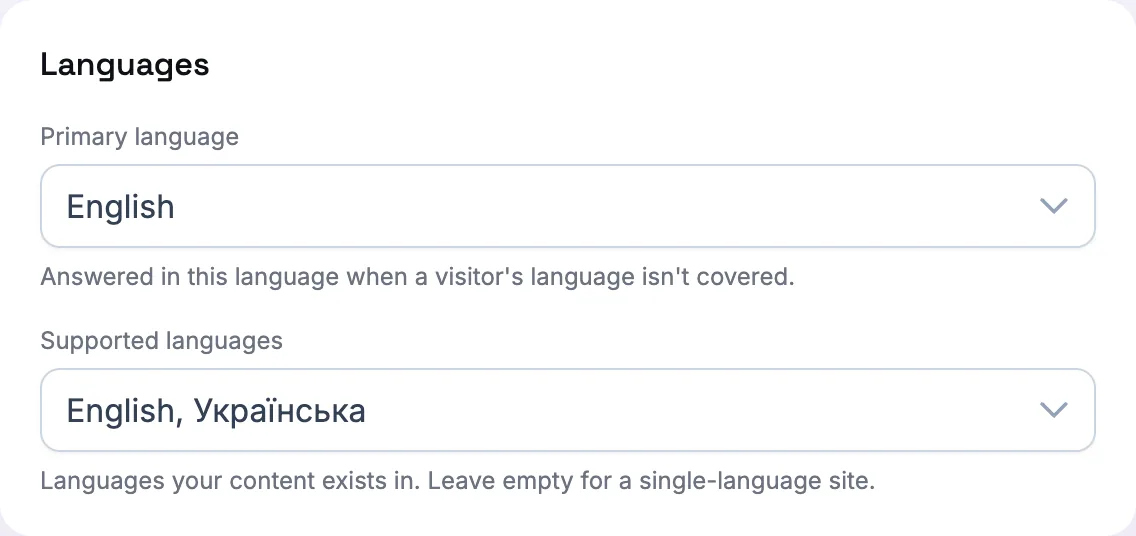
In your site's settings you list the languages you serve. That list decides which languages my greeting and chips come in, and which of your pages I prefer when the same thing is said in two — not which languages I answer in. I answer in all of them.
49 of them out loud.
For every spoken language there's a voice — picked for you, or chosen by you per language in the panel, with a sample before you pick. When a visitor talks to me, I listen in the language of their browser and where they are, or the page's; a small chip beside the microphone shows which, and one tap changes it.
Arabic and Hebrew read the right way.
On an Arabic or Hebrew site my whole interface reads right to left — the text, the buttons, the input. The corner I sit in stays where you put it. And a snippet of code inside an Arabic answer stays left to right, as code should.
Your panel, in your language.
17 languages, picked once, remembered. English and Ukrainian are written by hand; the rest are generated and read through — tell us where one reads wrong.
Limits, plainly.
- I answer in a language only as well as your pages let me: a question whose answer exists in Ukrainian only is answered in Polish from the Ukrainian page — accurately, but it's a translation of your words, not your words.
- The panel's 17 are the interface; answers come in any language, not only those.
Ask me in your language. Any of them.