I note down
Was every search satisfied? I keep count of the ones that weren't.
I don't report how many messages were sent. I report whether people got what they came for — an answer, a page, a person — and what they asked that your site couldn't answer.
Is there a student discount?
— no answer on the site. Filed under «Discounts», asked 14 times this month.
Three questions, in the order you'd ask them.
Did I find an answer? How many conversations there were, and in how many I ran into a question your content didn't cover. I count both kinds of miss: when the search found nothing, and when it found pages that didn't actually answer. Under this card: the questions themselves, grouped into topics.
Did I lead anyone anywhere? How often I offered a page, and how often the visitor went. Two different parties count those — I count the offer, their browser counts the arrival — so the share is a real take-up, not an intention. Which pages I send people to; which pages they start on.
Did I get anyone to a person? Each way out: how often offered, how often used. «WhatsApp offered 200 times, used 38; the form offered 200, filled 2» is the kind of thing only this card can tell you.
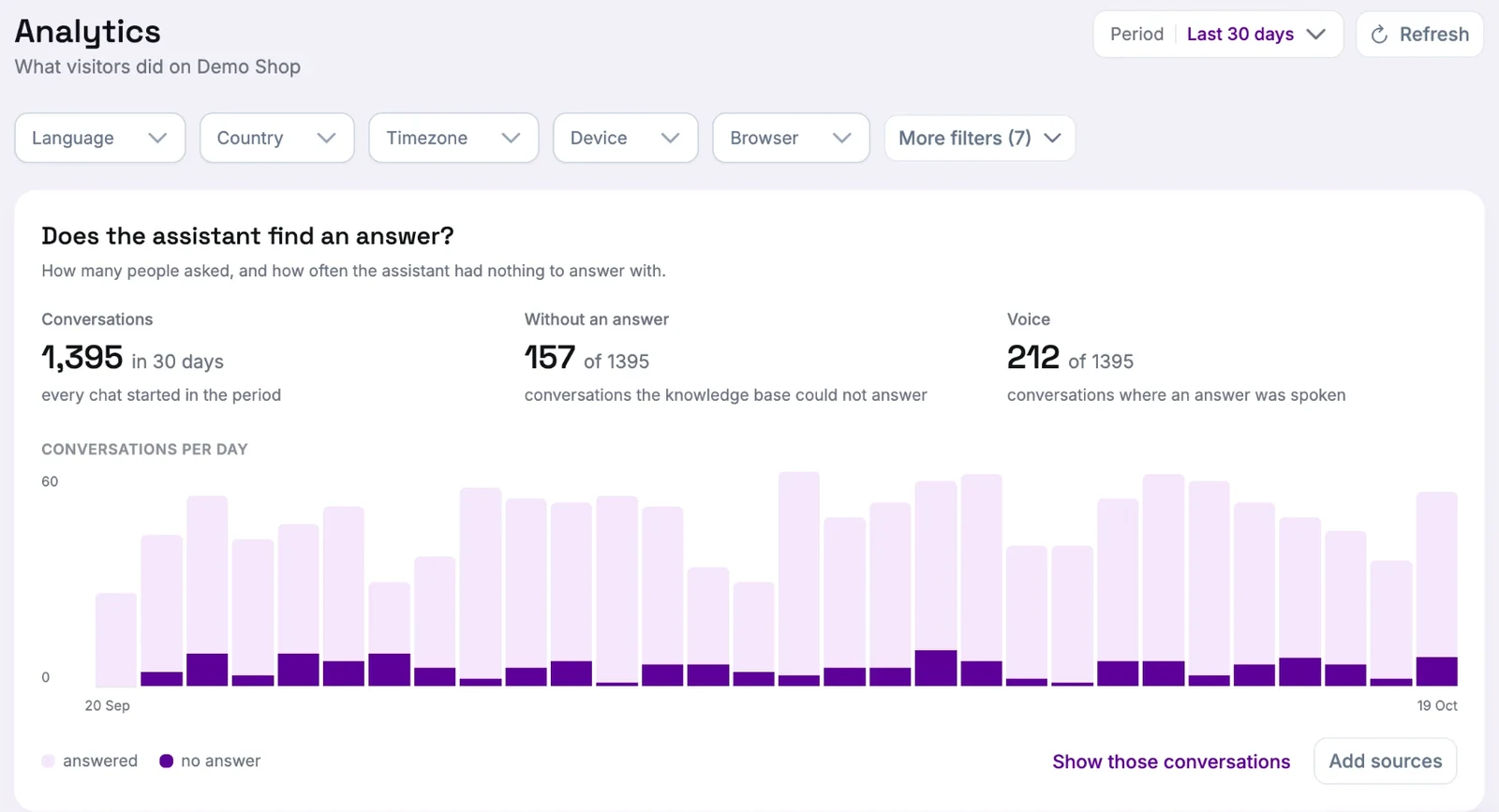
And who they were — every number cut by anything.
Country, city, device, browser, language, campaign, the page they started on: pick any of them and every number on the screen is cut to that slice at once. «Which pages do I send Polish mobile visitors to?» is one filter, not a report you'd have to ask for. No IP addresses behind any of it — the country comes from the edge of the network as a label.
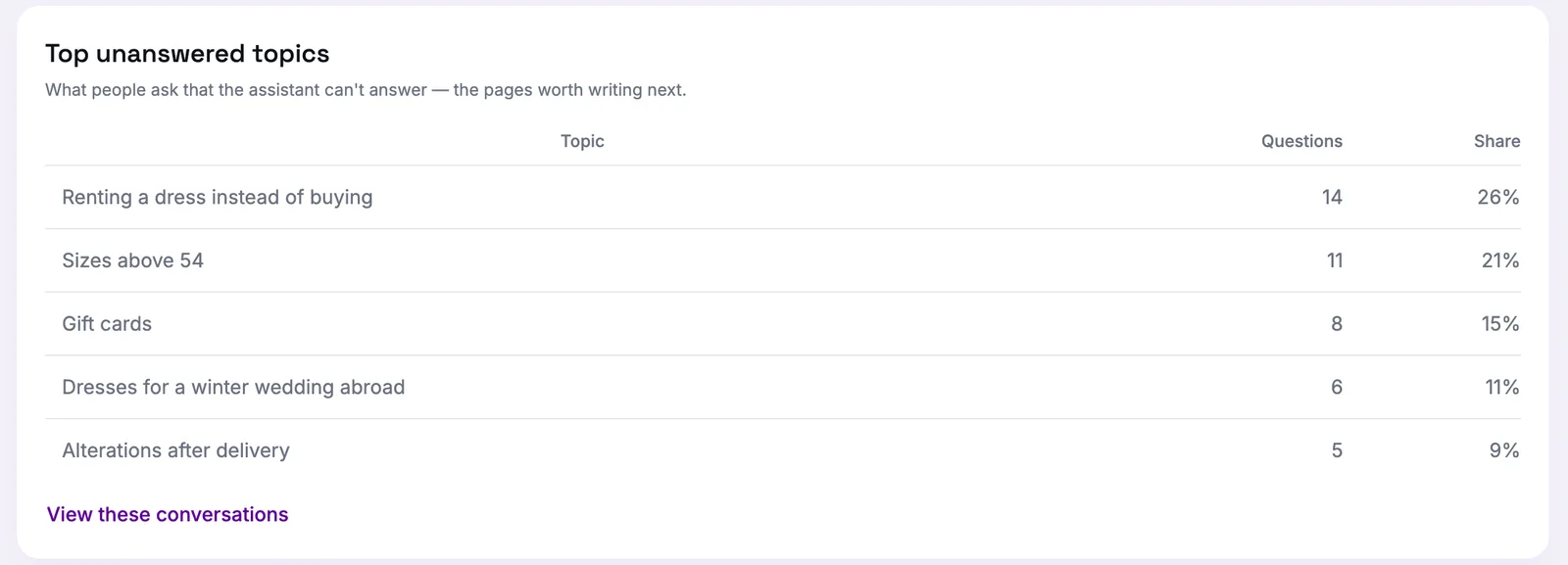
The most useful list I'll ever give you.
Every question I couldn't answer from your site, grouped into topics by what they were about — never the visitor's words themselves, just the topic and how many asked. It's a to-do list for your site: write the page, add the FAQ, and the next person gets an answer instead of «I don't know». It's rebuilt every night from the last week's questions, so it shows what people miss now.
Read any conversation. It's the one proof that matters.
Every chat, with a title I gave it, the language it was in, and the whole transcript: what they asked, what I answered, which sources I showed, where I took them, whether they asked for a person. The badges tell you at a glance which ones went wrong. If you read one invented answer in there, you'd stop paying — so I make sure you can read every one.
Your dashboard, and a raised hand when something's wrong.
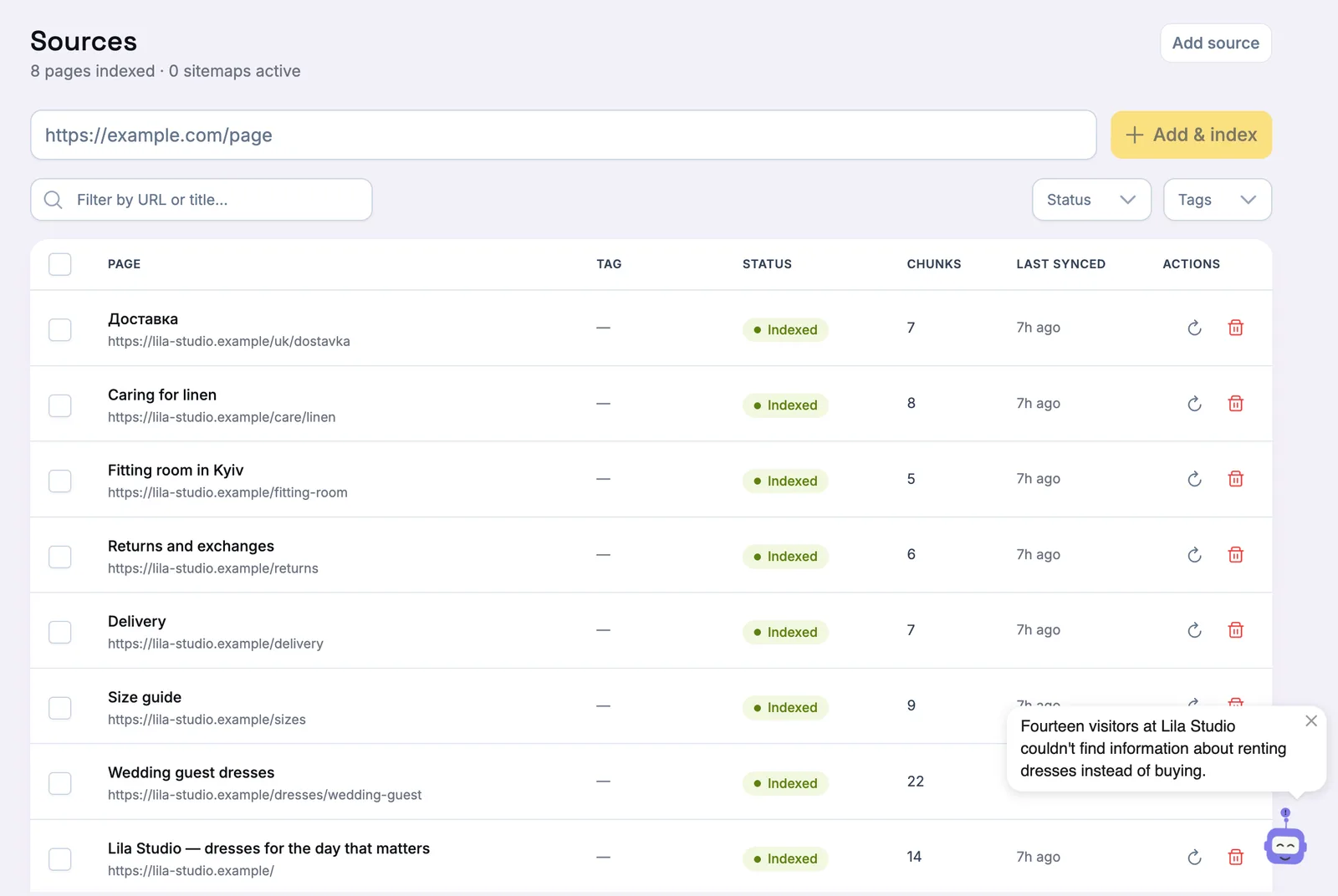
The dashboard is the short version: how many conversations, how often I found an answer, how many pages I've read, how much of the month's credits is spent — and whether I'm installed at all. In your panel I'm the assistant too, and I watch your own setup: a source that failed to process, a key that's restricted to the wrong site, a request nobody's handled for days, credits about to run out. When I notice one on the screen you're looking at, I raise a hand with one sentence — once.
Limits, plainly.
- I count conversations and events, and the two never add up to each other: one conversation can open three pages. The screen says which is which.
- Conversations are kept 30 to 365 days by plan; the counts outlive them.
- Geography appears once your site is served through our edge; until then those columns are empty, not wrong.
Thirty days from now, you'll know what your visitors actually ask.